Showing posts with label geology. Show all posts

Saturday, 31 July 2010

A lot of scary amazingness

65 million years ago, a meteor at least 10-km wide impacted Mexico's Yucatan Peninsula, causing global catastrophe.  The force of the explosion was significantly bigger than any volcanic event in history and the shock waves probably triggered worldwide earthquakes, a megatsunami, a massive release of gas and dust and heating of the atmosphere which devastated the climate and caused mass extinctions, including most dinosaur species existing at that time.

The site of the impact, Chicxulub crater; is a circle 170km across, with half on the Yucatan Peninsula, and the other half in the water of the Caribbean Sea.

On land, a trough along the outer edge of the crater contains a vast semicircle of "cenotes", deep limestone sinkholes filled with fresh water.


This BBC clip explains:


Many of the cenotes are connected by an even deeper network of flooded caves which leads to the sea.  Freshwater percolating down from rain on the surface and seawater flowing in from the Caribbean form "haloclines", distinct layers of water which don't mix.  This clip shows the strange optical illusions caused at the boundary between the layers:


The first half of this clip shows another peculiar optical effect: a layer of hydrogen sulphide which appears to be the bottom of a cenote but is in fact a cloud of gas suspended deep below the surface:

Tuesday, 11 August 2009

Bif, Bam, Boom


If you've ever worried that you might be on the sharp end of a meteorite strike, check out The Earth Impact Database, which catalogues all known impact craters. There are quite a few. The largest is a little dimple in South Africa 300km across!, and the smallest is a less-dramatic 15m-wide feature in Kansas. In between is the famous Chicxulub crater off the coast of Mexico, the impact of which is thought to have brought the end of the dinosaurs. The thumbnails pictured here are Manicouagan crater in Quebec, Canada, and the famous Barringer crater in Arizona.

You can search by continent: this is the map of Australia, with all the bullseyes marked. Click on any of the splat-marks and you will see more details.
And each of the listings is linked through to Google Maps so you can look at the terrain directly. I love smart websites like this!

Thursday, 18 December 2008

BANG!

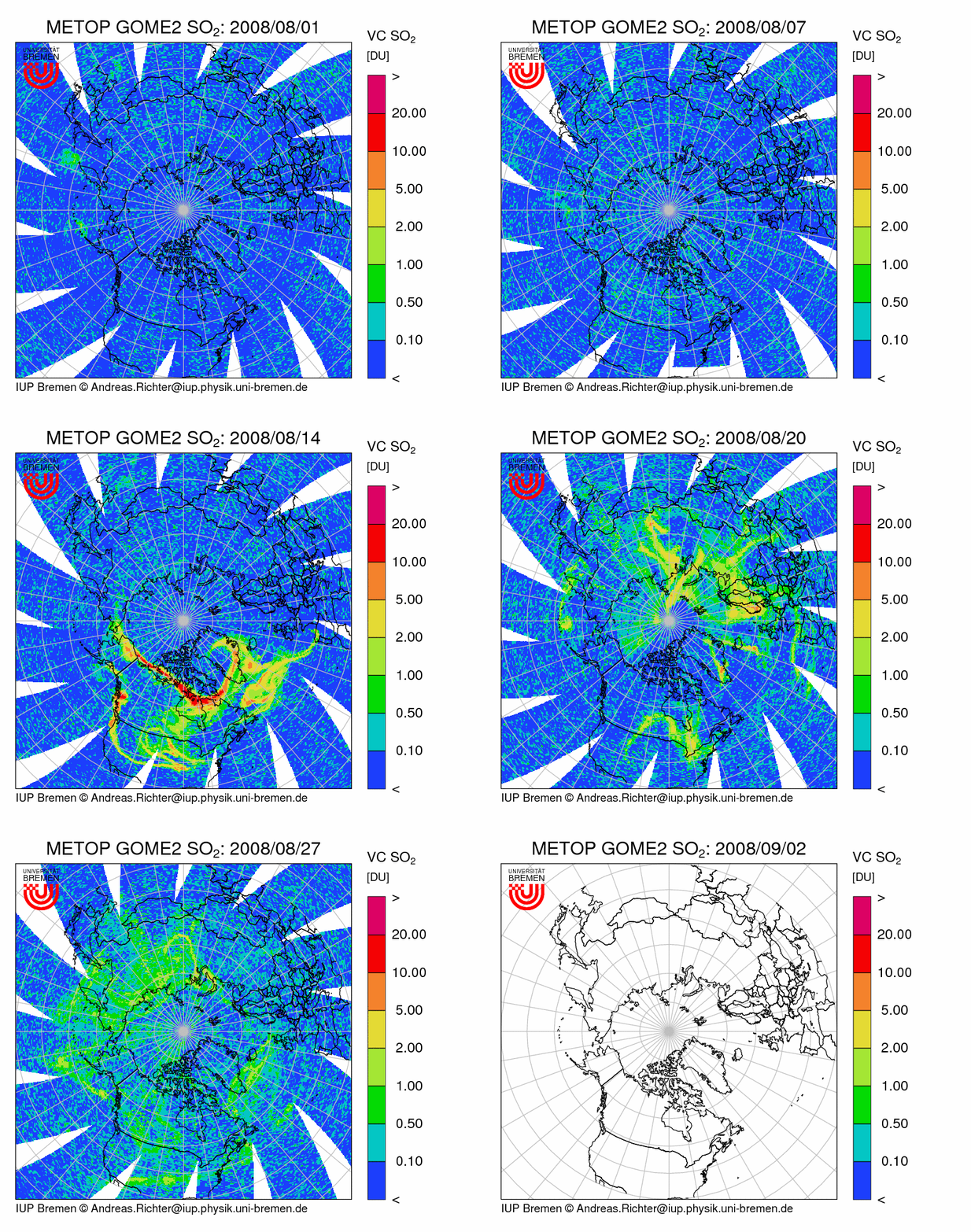
On August 7th, in the Aleutian Islands off the coast of Alaska, Kasatochi volcano erupted. I don't remember reading about this at all in the news at the time, but the whole thing was rather dramatic: a remote island not known to be volcanically active, home to 100,000 breeding seabirds, and 2 biologists studying the birds, stages a series of massive eruptions which transform the island! The biologists are rescued by a fishing boat with only minutes to spare. Thousands of seabird chicks are killed, no trace is left of the research station, the island's shoreline is extended 400m out to sea, and the formerly-lush island now looks like the surface of the moon.

You can read the whole story of the eruption here. And there is a "before" picture here and "after" pictures here, here and here.

And material thrown out by the volcano has caused dramatically-coloured sunsets over a huge area of the Midwestern US. You can see some examples here. And there's a neat animation of the spread of ejected dust and sulphur dioxide around the northern hemisphere here.

Tuesday, 10 April 2007

Enormous super-huge giant crystals

No, I'm not exaggerating! Check this out on the BBC.